


As we move through 2026, the speed of cyberattacks has transitioned from human-scale to machine-scale. Adversaries now use autonomous agents to identify and exploit vulnerabilities within minutes of their discovery, a phenomenon that has rendered traditional, manual patching cycles dangerously obsolete. In response, the industry is racing toward “Automated Remediation,” the use of AI and autonomous systems to not only detect vulnerabilities but to instantly apply fixes across the enterprise.
However, the transition to fully autonomous defense introduces a profound ethical and operational dilemma. If a machine-led patch causes a system-wide outage in a hospital’s patient record system or a bank’s transaction ledger, who is responsible? The promise of near-zero “Mean Time to Remediation” (MTTR) must be balanced against the risks of algorithmic bias, lack of transparency, and the potential for unintended cascading failures. This article explores the ethical framework required to manage the shift from human-led to machine-augmented security, providing a roadmap for when to trust the algorithm and when to keep a human in the loop.
The Moral Imperative of Speed vs. Stability
In the Post-Scanning Era, failing to automate is increasingly viewed as a failure of governance. When an organization leaves a known, critical vulnerability unpatched for weeks due to manual “change management” bureaucracy, it is essentially accepting a high probability of breach. The CISA Continuous Diagnostics and Mitigation (CDM) Program1 provides a dynamic approach to cybersecurity by replacing static, point in time audits with automated, near real-time visibility. By continuously identifying assets, monitoring vulnerabilities, and managing user privileges across federal networks, the program enables agencies to prioritize risks based on actual impact and significantly shorten the window of exposure for attackers.
To learn more about the strategic necessity of this transition,Stop Patching Everything: The Case for “Continuous Threat Exposure Management” (CTEM)2 argues that we must stop treating all patches as equal. Ethically, the highest priority for automation should be the “reachable” assets, those directly exposed to the internet. Automating the remediation of these high-risk endpoints is a moral imperative to protect customer data and organizational integrity.
The “Black Box” Problem: Transparency and Accountability
One of the central ethical concerns with AI-driven remediation is the “opacity” of deep learning models. If an AI decides to shut down a network segment to contain a suspected ransomware outbreak, it must be able to provide an interpretable reason for that action. Without “Explainable AI” (XAI), security teams cannot verify if the machine’s decision was based on a legitimate threat or a biased correlation in its training data.
As previously covered in Operationalizing Trust: Fixing the Broken Feedback Loop in Modern SOCs,3 trust cannot be “set and forget.” It requires a constant, closed-loop verification process. In an automated environment, this means the AI must “show its work.” According to a 2024 study on Ethical Challenges in AI-Driven Cybersecurity,4 the blurring lines of responsibility between human operators and autonomous systems present a significant legal and operational risk. If the “Deputy” (the AI) makes a mistake, the “Sheriff” (the CISO) still carries the accountability.
Algorithmic Bias and Resource Prioritization
Ethics in remediation also involves the fair distribution of security resources. Automated systems often prioritize assets based on “criticality” scores. However, if these scores are based on flawed data, the system may consistently neglect legacy systems or “niche” departments that are nonetheless vital to the organization’s overall health.
Rigorous API Asset Governance: Identifying and Decommissioning Obsolete Endpoints5 is a crucial prerequisite for ethical automation. An automated system cannot make ethical decisions about what to patch if it is working from an inaccurate map of the digital estate. If an “obsolete” endpoint is actually a critical legacy bridge for a specific user group, an automated “decommissioning” could result in discriminatory service loss.
This need for standardized ethics is echoed by the UNESCO Recommendation on the Ethics of Artificial Intelligence,6 which emphasizes “Proportionality and Do No Harm.” In cybersecurity, this means that an automated response must be proportional to the threat. Shutting down a whole server for a minor configuration drift is an unethical “over-remediation” that harms business continuity.
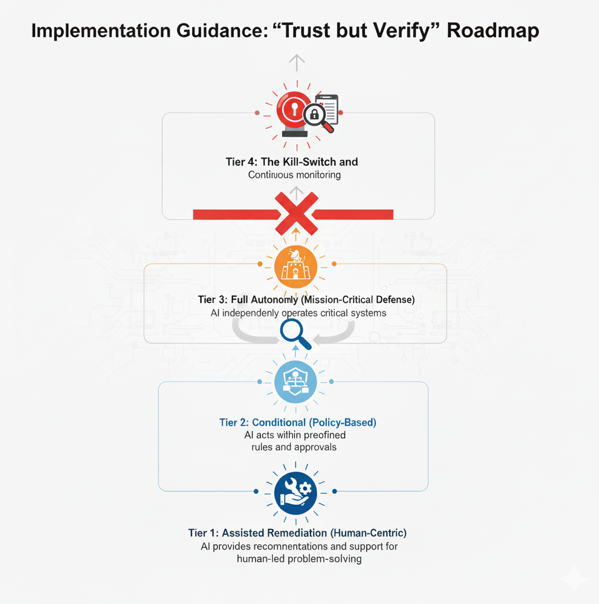
Implementation Guidance: The “Trust but Verify” Roadmap
To implement automated remediation ethically, business leaders should follow a tiered approach that gradually increases autonomy as the system proves its reliability.
Tier 1: Assisted Remediation (Human-Centric)
The AI identifies the fix and prepares the patch, but a human must click “Approve.”
- Use Case: High-criticality production databases or legacy systems with complex dependencies.
- Goal: Reduce the “Preparation Time” while maintaining absolute human control over the “Execution Time.”
Tier 2: Conditional Autonomy (Policy-Based)
The AI is permitted to patch automatically, but only within specific parameters (e.g., during maintenance windows or for specific low-risk software).
- Use Case: Standard desktop applications (browsers, office suites) and non-production environments.
- Guardrails: Implement an automated “Rollback” trigger if system performance metrics drop by more than 5% post-patch.
Tier 3: Full Autonomy (Mission-Critical Defense)
The AI acts in real-time to isolate threats or patch zero-day vulnerabilities without waiting for human intervention.
- Use Case: Defending against active ransomware spreading or brute-force API attacks.
- Ethics Check: Every autonomous action must generate an instant “Explanation Report” for the SOC to review post-event.
Tier 4: The Kill-Switch and Continuous Audit
No matter how advanced the AI becomes, it must remain auditable and stoppable.
- Manual Overrides: Ensure there is a physical or hard-coded “Kill-Switch” that can pause all autonomous remediation in the event of a system-wide “hallucination.”
- Continuous Auditing: Use a separate AI model to “audit” the decisions of the remediation AI, looking for patterns of bias or unnecessary risk-taking.
Ready to move from manual patching to autonomous defense? At Emutare, we bridge the gap between machine speed and human oversight. Our specialized services in Continuous Threat Exposure Management (CTEM) and API Asset Governance ensure your automated remediation is both ethical and effective. We help you operationalize trust through rigorous asset mapping and clear feedback loops within your SOC. Protect your mission critical systems from zero day threats without risking operational stability. Let Emutare elevate your team to algorithmic governors.
Conclusion
The question for 2026 is no longer if we should automate remediation, but how we do so without losing our grip on accountability. Automated remediation is the only way to survive the machine-speed threat landscape, but it must be governed by a framework of transparency and proportionality. By applying the principles of CTEM and rigorous asset governance, we can ensure that our autonomous defenses protect the business without breaking it.
True resilience in the Agentic AI era is not about removing humans from the loop; it is about elevating humans to the role of “Algorithmic Governors.” We provide the ethics, the context, and the oversight, while the machines provide the speed and the scale.
References
- Cybersecurity & Infrastructure Security Agency. Continuous Diagnostics and Mitigation (CDM) Program. https://www.cisa.gov/resources-tools/programs/continuous-diagnostics-and-mitigation-cdm-program ↩︎
- Emutare. (2025). Stop Patching Everything: The Case for “Continuous Threat Exposure Management” (CTEM). https://insights.emutare.com/stop-patching-everything-the-case-for-continuous-threat-exposure-management-ctem/ ↩︎
- Emutare. (2025). Operationalizing Trust: Fixing the Broken Feedback Loop in Modern SOCs. https://insights.emutare.com/operationalizing-trust-fixing-the-broken-feedback-loop-in-modern-socs/ ↩︎
- Cadet, E., Etim, E. D., Essien, I. A., Ajayi, J. O., & Erigha, E. D. (2024). Ethical challenges in AI-driven cybersecurity decision-making. International Journal of Scientific Research in Computer Science, Engineering and Information Technology, 10(3), 1031–1064. https://ijsrcseit.com/index.php/home/article/view/CSEIT25113577 ↩︎
- Emutare. (2025). API Asset Governance: Identifying and Decommissioning Obsolete Endpoints. https://insights.emutare.com/api-asset-governance-identifying-and-decommissioning-obsolete-endpoints/ ↩︎
- UNESCO. (2021). Recommendation on the Ethics of Artificial Intelligence. https://www.unesco.org/en/artificial-intelligence/recommendation-ethics ↩︎
Related Blog Posts
- Certificate-Based Authentication for Users and Devices: A Comprehensive Security Strategy
- IoT Security Challenges in Enterprise Environments
- Future of IoT Security: Regulations and Technologies
- Risk-Based Authentication: Adaptive Security
- IoT Threat Modeling and Risk Assessment: Securing the Connected Ecosystem
- Red Team vs. Blue Team vs. Purple Team Exercises: Strengthening Your Organization’s Security Posture
- AI Security: Protecting Machine Learning Systems