


In the boardroom of 2026, the conversation around cybersecurity has undergone a fundamental transformation. It is no longer a “technical problem” to be buried in an IT budget; it is a critical business risk that sits alongside financial stability and brand reputation. However, for many growing businesses, a significant hurdle remains. The median annual compensation for a full-time Chief Information Security Officer (CISO) in 2026 has climbed to roughly $350,000, with some major markets seeing total packages exceeding $500,000 when benefits and equity are included, as seen in 2026 CISO Annual Compensation Averages $350K, Tops $1M For Some.1
This price tag creates a dangerous vacuum. Mid-sized companies often find themselves “too big to ignore security” but “too small to afford a full-time executive.” This gap is being filled by a new model of strategic leadership: the Fractional CISO. By providing high-level security governance as a service, this model allows businesses to access elite expertise without the prohibitive overhead of a permanent hire.
The Strategic Leadership Deficit
For a growing business, cybersecurity maturity is rarely a straight line. Often, the realization that specialized leadership is needed comes during a high-stakes event, such as a major audit, a complex insurance renewal, or the aftermath of a security incident. Without a dedicated leader, these responsibilities often fall onto the shoulders of a CTO or IT Manager who, while technically gifted, may lack the specialized focus on risk governance and regulatory compliance.
This is where the distinction between “IT management” and “Security leadership” becomes vital. To learn more about how these roles differ within a maturing organization, one can examine the Security Technology Stack for Growing Businesses.2 While an IT team focuses on making systems work, a CISO focuses on ensuring those systems are resilient against exploitation. A Fractional CISO steps in not as a technician, but as a strategist who aligns security investments with business goals.
The Economics of Expertise in 2026
The shift toward “Leadership as a Service” is backed by compelling data. Recent benchmarks from 2026 indicate that a fractional engagement typically costs between $36,000 and $180,000 per year, representing significant savings compared to a full-time executive. This economic efficiency does not come at the cost of quality. In fact, Fractional CISOs often bring a broader perspective because they serve multiple organizations across different sectors, allowing them to spot emerging threat patterns faster than a siloed professional might.
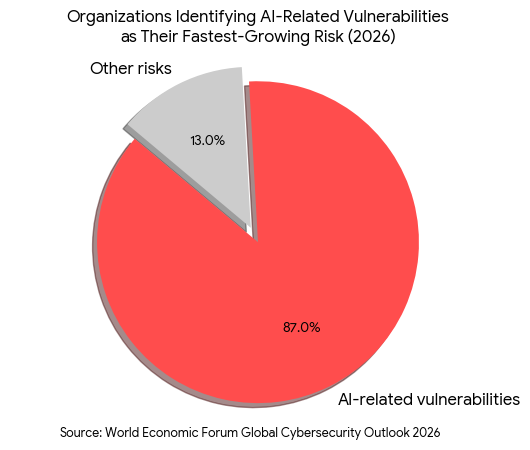
According to the Global Cybersecurity Outlook 20263 published by the World Economic Forum, 87% of organizations now identify AI-related vulnerabilities as their fastest-growing risk. Managing this specific threat requires a level of specialized knowledge that is difficult to find and even harder to retain. A Fractional CISO provides immediate access to this “high-tier” talent, helping a business navigate the complexities of AI governance and secure automation without the multi-month delay of a traditional executive search.
Bridging the Gap: Identity and Risk
One of the first tasks a Fractional CISO undertakes is the stabilization of the organization’s most critical assets. In today’s decentralized work environment, that almost always starts with identity. As previously covered in our deep dive into Directory Services Security: Active Directory and Beyond,4 compromised credentials remain the primary entry point for attackers.
A Fractional CISO doesn’t just “check the boxes” on a security list; they build a roadmap. They evaluate the current state of directory services and implement modern controls like phishing-resistant Multi-Factor Authentication (MFA) and Zero Trust architecture. By treating identity as the new perimeter, they provide a scalable security foundation that grows alongside the company.
This leadership is equally critical when it comes to the “noise” of modern cybersecurity. The sheer volume of technical alerts can overwhelm a small team. A strategic leader applies the principles of Risk-Based Vulnerability Prioritization5 to ensure the team is fixing the right things. Instead of chasing every minor software bug, the Fractional CISO identifies the vulnerabilities that pose a genuine threat to business continuity, effectively acting as a “force multiplier” for the existing IT staff.
The Compliance Catalyst
For many SMEs, the primary driver for hiring a Fractional CISO is no longer just “protection,” but “permission.” In 2026, global supply chains have become highly scrutinized. To win a contract with a Fortune 500 company or a government agency, a business must often demonstrate compliance with frameworks like SOC 2, ISO 27001, or CMMC 2.0.
Research from Capgemini on Trends in Cybersecurity 2025/20266 underscores that cybersecurity is moving from a defensive obligation to a strategic advantage. Organizations that can demonstrate demonstrable resilience are more likely to win trust and close deals faster. A Fractional CISO leads this effort, translating complex legal requirements into actionable IT policies. They act as the professional face of the company’s security program during meetings with auditors, investors, or the board of directors.
Practical Implementation: Maximizing the Fractional Model
To successfully integrate a Fractional CISO, a business must move beyond a “vendor” mindset and treat the individual as a true member of the executive team. Here is how to ensure the partnership delivers maximum value:
1. Define Clear “Triggers” for Engagement
Don’t wait for a breach to seek leadership. Common triggers include preparing for an IPO, expanding into a new geographic market, or undergoing a major cloud migration. Identifying these milestones early allows the Fractional CISO to build security into the project from day one.
2. Empower Them with Authority
A leader without the power to influence policy is merely a consultant. To be effective, a Fractional CISO needs the backing of the CEO to implement necessary changes, even if those changes occasionally introduce a slight friction into existing workflows.
3. Focus on Culture, Not Just Code
The most effective security programs are human-centric. A Fractional CISO should spend time educating the staff and fostering a “security-first” culture. Research published in the International Journal on Informatics Visualization suggests that organizations with mature security cultures see a significant reduction in successful social engineering attacks.
4. Establish Performance Metrics
Move away from “number of blocked attacks” as a metric. Instead, look at strategic indicators like Mean Time to Detect (MTTD), the percentage of high-risk vulnerabilities patched within a set window, and the successful completion of annual compliance audits.
Conclusion
The “Fractional CISO” is more than a cost-saving measure; it is a strategic evolution for the modern enterprise. In an era where threats move at the speed of AI and regulations change by the month, no business can afford to be without expert guidance. By decoupling elite security leadership from the traditional full-time employment model, companies can finally achieve the level of resilience they need to compete on a global stage.
Whether it is navigating the intricacies of directory security, prioritizing vulnerabilities, or building a tech stack that can withstand the tests of 2026, the Fractional CISO provides the steady hand at the helm. Security is a journey, not a destination, and having an experienced guide makes all the difference.
Secure Your Growth with Emutare
Is your business too large to ignore security but too small for a full-time executive? Emutare bridges this gap. Our Fractional CISO services provide elite strategic leadership tailored to your budget. We specialize in stabilizing critical assets through robust directory services security and risk-based vulnerability prioritization. Whether navigating AI governance or achieving SOC 2 compliance, our experts align security investments with your business goals. Contact Emutare today to build a resilient, security-first culture that turns technical defense into a strategic advantage
References
- RSA Conference. (2026). 2026 CISO Annual Compensation Averages $350K, Tops $1M For Some. https://www.rsaconference.com/library/blog/2026-ciso-annual-compensation-averages-350k-tops-1m-for-some ↩︎
- Emutare. (2025). Security Technology Stack for Growing Businesses. https://insights.emutare.com/security-technology-stack-for-growing-businesses/ ↩︎
- World Economic Forum. (2026). Global Cybersecurity Outlook 2026. https://reports.weforum.org/docs/WEF_Global_Cybersecurity_Outlook_2026.pdf ↩︎
- Emutare. (2025). Directory Services Security: Active Directory and Beyond. https://insights.emutare.com/directory-services-security-active-directory-and-beyond/ ↩︎
- Emutare. (2025). Risk-Based Vulnerability Prioritization: A Strategic Approach to Modern Cybersecurity. https://insights.emutare.com/risk-based-vulnerability-prioritization-a-strategic-approach-to-modern-cybersecurity/ ↩︎
- Capgemini. (2025). Trends in Cybersecurity 2025/2026. https://www.capgemini.com/nl-nl/wp-content/uploads/sites/19/2025/09/Trends-in-Cybersecurity_Eng_Digital_2-1.pdf ↩︎
Related Blog Posts
- Advanced Anti-Phishing Controls and User Training: Building Resilient Cybersecurity Defenses
- Board Reporting on Cybersecurity: What Executives Need to Know
- Multi-Factor Authentication: Comparing Different Methods
- Secrets Management in DevOps Environments: Securing the Modern Software Development Lifecycle
- Zero Trust for Remote Work: Practical Implementation
- DevSecOps for Cloud: Integrating Security into CI/CD
- Customer Identity and Access Management (CIAM): The Competitive Edge for Australian Businesses