


For decades, the cybersecurity industry has been predicting the “death of the password.” In 2026, we are finally watching the funeral procession.
Driven by the FIDO Alliance and the ubiquity of biometric sensors on consumer devices, “Passkeys” have rapidly moved from a niche standard to the default authentication method for millions of users. The promise is alluring: a world where phishing is mathematically impossible because there are no credentials to steal, and where user friction is reduced to a simple glance or fingerprint scan.
However, as organizations rush to adopt this passwordless future, they are discovering a complex reality. Removing the password does not remove the risk; it simply shifts it. We are entering a “Passkey-First” world, but for enterprise security teams, this shift introduces profound new challenges in governance, recovery, and session management.
The question is no longer “how do we deploy passkeys?” but rather “how do we manage identity when the ‘keys’ are stored on unmanaged devices?”
1. The “Break Glass” Problem: Operationalizing Recovery
The most immediate challenge in a passwordless environment is not authentication, but recovery. In the old world, if a user forgot their password, they reset it via an email link. In the passkey world, the private key lives on the hardware device. If an employee loses their phone or breaks their laptop, they have not just lost a device; they have lost their identity.
This creates a critical “Break Glass” scenario. If your recovery process relies on falling back to a password (e.g., “I lost my device, let me log in with a password instead”), you have negated the entire security benefit of the passkey. Attackers simply target the recovery flow instead of the primary flow.
According to a 2025 academic review Challenges and Potential Improvements for Passkey Adoption-A Literature Review with a User-Centric Perspective1 published by MDPI, technical issues regarding account recovery remain one of the primary barriers to enterprise adoption. The research highlights that without a robust, non-password recovery mechanism, organizations are forced to maintain legacy credential databases, effectively doubling their attack surface.
The ChatOps Solution
This is where operational speed and verification meet. A secure recovery process requires high-fidelity identity verification (IDV).
As we explored in our guide on ChatOps for Security Teams: Enhancing Collaboration,2 modern collaboration platforms can serve as the secure bridge for these moments. Instead of a helpdesk ticket that takes hours (or a weak email reset), a user can initiate a “Device Lost” workflow via a secure bot.
The bot can challenge the user with context-aware questions or trigger a video verification workflow before provisioning a temporary, time-bound access token. This keeps the recovery process entirely passwordless and audit-trailled within the chat platform, ensuring that the “Break Glass” mechanism is as secure as the front door.
2. The New Perimeter: Protecting the Session, Not the Login
The second major shift in 2026 is the evolution of the attack vector. Passkeys are exceptionally good at preventing credential theft. They are, however, powerless against “Session Token Theft.”
When a user logs in (whether via password or passkey), the application issues a “Session Token” (a cookie) that allows the user to remain logged in. Sophisticated adversaries have realized they no longer need to break into the house; they just need to steal the visitor badge.
Recent analysis from Microsoft’s Digital Defense Report 20243 indicates a surge in “Token Replay” attacks, where malware on an endpoint exfiltrates these tokens, allowing attackers to bypass authentication entirely. In this scenario, it does not matter how strong your passkey was; the attacker has already walked past the checkpoint.
Visibility into the Invisible
To combat this, security leaders must shift their focus from “preventing unauthorized logins” to “continuous session monitoring.” This requires deep visibility into the behavior of authenticated users.
This aligns with the principles we discussed in SaaS Security Posture Management for Critical Business Applications.4 A robust SaaS security program does not just check configurations; it monitors for anomalies such as a session token that was issued in New York being used 10 minutes later in London.
In a passkey-first world, the SaaS Security Posture Management (SSPM) tool becomes the primary line of defense. It detects the “impossible travel” or the “unusual download volume” that indicates a stolen token, triggering an immediate revocation of access regardless of how the user authenticated.
3. The “Shadow Identity” Crisis
The third challenge is governance. Passkeys are often synced across personal cloud ecosystems (like iCloud or Google Password Manager). While this is convenient for users, it creates a “Shadow Identity” problem for the enterprise.
If an employee creates a passkey for a corporate Salesforce account and stores it in their personal iCloud Keychain, the organization has lost control of that credential. If the employee leaves the company, IT cannot “wipe” the passkey from their personal iPhone. The user technically retains a valid entry method.
The Governance Gap
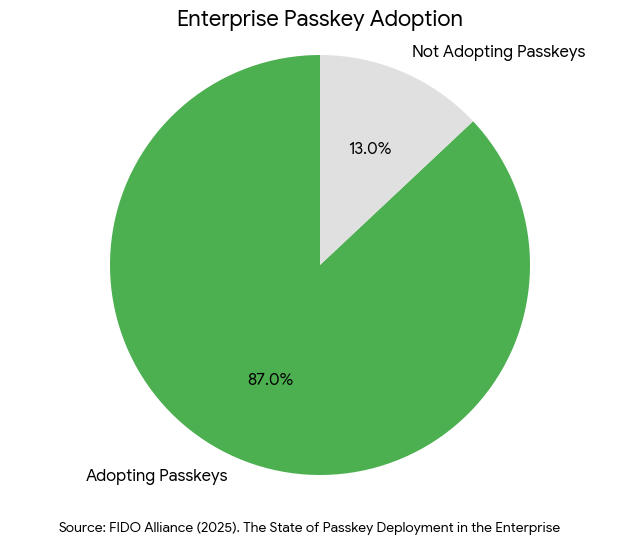
The FIDO Alliance’s The State of Passkey Deployment in the Enterprise5 notes that while 87% of enterprises are adopting passkeys, a significant portion struggle to distinguish between “managed” (device-bound) and “unmanaged” (synced) keys.
Governance policies must be updated to address this nuance. Organizations need to enforce policies that restrict where corporate passkeys can be stored. This might involve mandating the use of enterprise-managed password managers or hardware security keys (like YubiKeys) for high-value accounts, ensuring that the company retains ownership of the credentials.
This governance extends to the concept of SaaS Security Posture Management for Critical Business Applications, where automated tools can audit which users are accessing applications via unmanaged devices or unauthorized identity providers, bringing these “Shadow Identities” back under corporate control.
4. The Economic Case: Justifying the Transition
Finally, moving to a passwordless infrastructure is not free. It requires investment in hardware keys, updated Identity and Access Management (IAM) licensing, and user training.
Security leaders must articulate the Return on Investment (ROI) of this transition. As detailed in our framework for Measuring ROI of Threat Intelligence Programs,6 the value must be framed in terms of “Risk Avoidance” and “Operational Efficiency.”
- Hard Costs: Eliminate the cost of password reset tickets, which can account for up to 30% of IT helpdesk volume.
- Soft Costs: Quantify the reduction in phishing risk. If a passkey eliminates the possibility of credential harvesting, you have effectively removed the vector responsible for the vast majority of initial breaches.
By using the ROI models we advocate for, CISOs can demonstrate that the cost of deploying passkeys is a fraction of the potential cost of a single session-hijacking incident.
5. Implementation Guidance for the Hybrid Era
We are not yet in a purely passwordless world. We are in a hybrid era, which is often messier. To navigate this transition effectively, we recommend the following phased approach.
Phase 1: The Inventory and Audit
You cannot secure what you do not know.
- Identify Authentication Methods: Use your SSPM tools to audit your current SaaS estate. Which apps support SSO (Single Sign-On)? Which supports WebAuthn? Which are still stuck on username/password?
- Classify Users: Segment your user base. High-privilege admins may require hardware keys immediately, while general staff can utilize platform biometrics (FaceID/TouchID).
Phase 2: Secure the Recovery Flow
Close the backdoor before you lock the front door.
- Define the “Lost Device” Protocol: Document exactly how a user regains access without a password.
- Leverage ChatOps: Build the automation that allows a verified manager to approve a temporary access token via Slack or Teams.
Phase 3: Continuous Session Assurance
Shift from gatekeeping to lifeguarding.
- Shorten Session Lifetimes: If you cannot prevent token theft, you can limit its utility. Reduce the Time-to-Live (TTL) for session cookies on critical apps.
- Monitor Anomalies: Tune your SIEM or SaaS security tools to flag “Session Replay” indicators, such as a token being used from a browser fingerprint that does not match the original issuer.
Conclusion
The shift to a “Passkey-First” world is the most significant upgrade to digital identity in thirty years. It offers a path to an enterprise that is both more secure and more usable. However, it is not a “set and forget” technology.
As reliance on passwords fades, the focus of the security team must pivot. We must move away from the static defense of credentials and toward the dynamic defense of sessions and identities. We must ensure that our governance models account for the personal devices that now hold corporate keys. And we must ensure that our recovery processes do not become the new weak link.
By combining the visibility of SaaS Security Posture Management, the agility of ChatOps, and the strategic foresight of Threat Intelligence, organizations can move beyond the password, not just in technology, but in mindset.
Navigating the shift to a passkey-first world requires more than just technology; it demands robust strategy and control. Emutare empowers your organization to manage these new identity risks effectively. Our Cybersecurity Governance solutions help you regain control over “shadow identities” and unmanaged credentials. We provide expert Cybersecurity Advisory to refine your risk management frameworks and recovery policies. Additionally, our Cybersecurity Awareness Training ensures your workforce is ready to adapt to these evolving authentication standards. Partner with Emutare to build a resilient, secure digital landscape today.
References
- MDPI (2025). Challenges and Potential Improvements for Passkey Adoption-A Literature Review with a User-Centric Perspective. https://www.mdpi.com/2076-3417/15/8/4414 ↩︎
- Emutare. (2025). ChatOps for Security Teams: Enhancing Collaboration. https://insights.emutare.com/chatops-for-security-teams-enhancing-collaboration/ ↩︎
- Microsoft. (2024). Digital Defense Report 2024. https://cdn-dynmedia-1.microsoft.com/is/content/microsoftcorp/microsoft/final/en-us/microsoft-brand/documents/Microsoft%20Digital%20Defense%20Report%202024%20%281%29.pdf? ↩︎
- Emutare. (2025). SaaS Security Posture Management for Critical Business Applications. https://insights.emutare.com/saas-security-posture-management-for-critical-business-applications/ ↩︎
- FIDO Alliance (2025). The State of Passkey Deployment in the Enterprise. https://cpl.thalesgroup.com/sites/default/files/content/analyst_research/The-State-of-Passkey-Deployment-in-the-Enterprise-in-the-US-and-UK-FIDO-Alliance.pdf ↩︎
- Emutare. (2025). Measuring ROI of Threat Intelligence Programs: A Strategic Framework for Australian Organizations. https://insights.emutare.com/measuring-roi-of-threat-intelligence-programs-a-strategic-framework-for-australian-organizations/ ↩︎
Related Blog Posts
- Network Security Zoning and Segmentation Design: Building Resilient Digital Perimeters in 2025
- Threat Intelligence Sharing: Communities and Frameworks
- Healthcare Information Security: Australian Privacy Requirements
- Cost-Effective Security Solutions for Limited Budgets
- Threat Hunting: Methodologies and Tools
- Email Data Loss Prevention Strategies: A Comprehensive Guide for Australian Organizations
- Alert Fatigue: Strategies for Effective Prioritization