

The cybersecurity arms race of 2026 has reached a new velocity. We have moved beyond the era of static scripts and periodic penetration tests into the age of “Artificial Adversaries.” Today, threat actors utilize autonomous agents to conduct multi-stage campaigns; reconnaissance, initial access, lateral movement, and exfiltration, without human intervention. For the modern enterprise, a human-led red team that meets once a quarter is no longer a sufficient defense against a machine that probes your network once a second.
Enter Agentic Red Teaming. This paradigm shift involves deploying your own “Swarm” of AI agents to continuously and autonomously attack your infrastructure. Unlike traditional automated scanners that look for known CVEs, agentic red teaming uses Large Language Models (LLMs) and reinforcement learning to emulate the creativity and persistence of a human hacker. These agents can reason through complex environments, chain together minor misconfigurations, and discover “prompt paths” to exploit internal AI systems. To stay resilient, business leaders must learn to fight fire with fire, using autonomous offensive AI to find their weaknesses before a real attacker does.
The Shift from Unit Tests to “AI Evals” and Autonomous Probing
In traditional software engineering, security was often handled through deterministic unit tests: if input X occurs, the system must respond with Y. However, generative AI and agentic systems are probabilistic, meaning they do not always give the same answer twice. This unpredictability makes traditional testing models brittle.
As previously covered in Operationalizing Trust: Fixing the Broken Feedback Loop in Modern SOCs,1 the security operations center (SOC) must evolve from manual investigation to the supervision of autonomous workflows. Agentic red teaming is the offensive counterpart to this evolution. By 2026, the new standard for quality is “AI Evals”—dynamic datasets and agents designed to grade your system’s behavior under pressure.
Microsoft’s How to Secure Enterprises from Agentic AI Risks2 report highlights that while 80% of Fortune 500 companies have adopted agentic AI, many remain vulnerable to the “Double Agent” phenomenon. Their research emphasizes that static evaluations fail to detect vulnerabilities like reasoning redirection, where an agent’s task framing is manipulated through everyday content. Microsoft argues that because agents operate at “machine speed” across interconnected systems, security must shift from testing individual models to probing end-to-end autonomous workflows. By using AI to “jailbreak” your own safety filters, you can identify where a model might hallucinate a dangerous answer or leak competitor data before it ever reaches a customer.
Multi-Agent Systems: Emulating the Professional Attack Team
Real-world hacking is rarely a solo act; it involves specialized roles for reconnaissance, payload delivery, and data exfiltration. Academic research has recently moved toward “Multi-Agent Systems” (MAS) to better mirror this division of labor. For instance, a recent paper on LLM-Based Multi-Agent Autonomous Penetration Testing3 introduces frameworks like “AutoAttacker,” where specialized agents coordinate to execute complex attack phases.
This coordinated approach is essential for identifying the “deep” vulnerabilities that traditional scanners miss. An agentic red team might find that a seemingly harmless internal API can be tricked into revealing sensitive data if the agent first gains low-level access through a separate, unpatched endpoint.
To learn more about how these interconnected vulnerabilities create risk, API Asset Governance: Identifying and Decommissioning Obsolete Endpoints4 emphasizes that “Zombie APIs” are the preferred playground for autonomous agents. If an obsolete endpoint is still active, an agentic red team will find it, document the path to exploitation, and alert the governance team—all while the human security staff is focused on other tasks.
Continuous Exposure Management: The New Offensive Baseline
The ultimate goal of agentic red teaming is to transform “Penetration Testing” from a project milestone into a continuous background process. This is the “Validation” stage of Continuous Threat Exposure Management (CTEM).
As explored in Stop Patching Everything: The Case for “Continuous Threat Exposure Management” (CTEM),5 the value of security automation is not just in finding bugs, but in prioritizing them based on “exploitability.” An AI agent provides the ultimate proof of exploitability: if the machine can actually breach the system, the vulnerability is a Tier 1 priority.
Unlike traditional AI that follows static rules, agentic systems use cognitive architectures and reinforcement learning to autonomously plan and execute workflows (Achuthan, 2024). This allows them to manage complex Security Operations Center (SOC) tasks such as alert triage, incident response, and vulnerability management (Malatji, 2025).6 By using red team agents to stress-test these recommendations, organizations ensure that their defenses are “battle-tested” against the most current adversarial techniques.
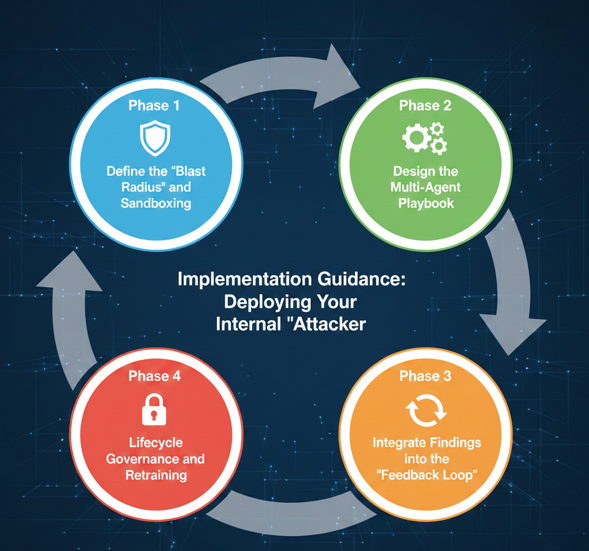
Implementation Guidance: Deploying Your Internal “Attacker”
Adopting agentic red teaming requires a shift in mindset and a structured approach to prevent the “testing” tool from becoming a liability itself.
Phase 1: Define the “Blast Radius” and Sandboxing
Autonomous agents are powerful; they must be pointed at the right targets.
- Isolate the Test Environment: Run initial agentic tests in a “Digital Twin” or staging environment that mirrors production.
- Implement “Kill Switches”: Ensure that if an agent begins to consume excessive resources or triggers a critical system failure, it can be paused instantly.
Phase 2: Design the Multi-Agent Playbook
Assign specific “Personalities” to your red team agents to ensure comprehensive coverage.
- The Recon Specialist: Tasked with finding undocumented APIs and “Shadow IT” assets.
- The Social Engineer: Uses LLMs to draft sophisticated internal phishing lures to test employee awareness and “Identity Security Posture.”
- The LLM Jailbreaker: Specifically probes your internal AI assistants for prompt injection and data leakage risks.
Phase 3: Integrate Findings into the “Feedback Loop”
The value of a red team is zero if the results are not actionable.
- Automate Ticketing: Link agent findings directly to developer backlogs with a full “Proof of Concept” (PoC) video or log generated by the AI.
- Reward Success: Use agentic results to gamify security, rewarding teams that successfully defend against the “Swarm.”
Phase 4: Lifecycle Governance and Retraining
As the threat landscape changes, so must your agents.
- Update Threat Intel: Regularly feed your agents the latest “Adversary Tactics, Techniques, and Procedures” (TTPs) from global threat feeds.
- Model Alignment: Ensure your red team agents are “aligned” to follow legal and ethical guidelines, preventing them from accidentally causing real-world harm during a test.
Conclusion
In 2026, the perimeter is no longer a wall; it is a fluid, high-speed exchange of data and identities. Traditional security models that rely on “hoping” for the best are being replaced by models that “prove” the best through continuous adversarial simulation. Agentic red teaming is not just an “advanced” security feature; it is the fundamental way we will maintain operational trust in an automated world.
By leveraging AI to find our own weaknesses, we don’t just close vulnerabilities; we build a culture of continuous resilience. We move from a state of being “the hunted” to a state of being “the prepared,” ensuring that when a real artificial adversary arrives, they find a system that has already defeated its own best attackers a thousand times over.
The cybersecurity landscape moves at machine speed. Emutare provides the strategic offensive and defensive services you need to stay ahead. We specialize in Continuous Threat Exposure Management (CTEM) to prioritize your most critical risks and API Asset Governance to eliminate dangerous “Zombie APIs”. Our expertise in SOC automation transforms your security operations into an autonomous, proactive powerhouse.
Don’t wait for a breach to discover your vulnerabilities. Let Emutare help you build a battle-tested defense today
References
- Emutare. (2025). Operationalizing Trust: Fixing the Broken Feedback Loop in Modern SOCs. https://insights.emutare.com/operationalizing-trust-fixing-the-broken-feedback-loop-in-modern-socs/ ↩︎
- Cyber Magazine. (2026). Microsoft: How to Secure Enterprises from Agentic AI Risks. https://cybermagazine.com/news/microsoft-how-to-secure-enterprises-from-agentic-ai-risks ↩︎
- Wu, X., Tian, Y., Chen, Y., Ye, P., Cui, X., Jia, J., Li, S., Liu, J., & Niu, W. (2025). Curriculumpt: Llm-Based Multi-Agent Autonomous Penetration Testing With Curriculum-Guided Task Scheduling. Applied Sciences, 15(16), Article 9096. https://www.mdpi.com/2076-3417/15/16/9096 ↩︎
- Emutare. (2025). API Asset Governance: Identifying and Decommissioning Obsolete Endpoints. https://insights.emutare.com/api-asset-governance-identifying-and-decommissioning-obsolete-endpoints/ ↩︎
- Emutare. (2025). Stop Patching Everything: The Case for “Continuous Threat Exposure Management” (CTEM). https://insights.emutare.com/stop-patching-everything-the-case-for-continuous-threat-exposure-management-ctem/ ↩︎
- Malatji, M. (2025). A cybersecurity AI agent selection and decision support framework. arXiv.https://arxiv.org/pdf/2510.0175 ↩︎
Related Blog Posts
- GDPR Compliance for Australian Companies with EU Customers: A Comprehensive Guide for 2025
- Developing Cyber Threat Intelligence Requirements: A Strategic Framework for Modern Organizations
- Cybersecurity Insurance for Australian SMBs: A Critical Shield Against Rising Cyber Threats
- Securing Data Pipelines for AI Training: A Comprehensive Guide for Australian Enterprises
- Hash Functions and Their Applications in Security
- PCI DSS: Implementation Guide for Australian Merchants
- Managed Security Services: When to Outsource